


Warning: Estimated delivery time min. 10 working days
More informationGiant otter
Pteronura brasiliensis
Natural diet Giant otter
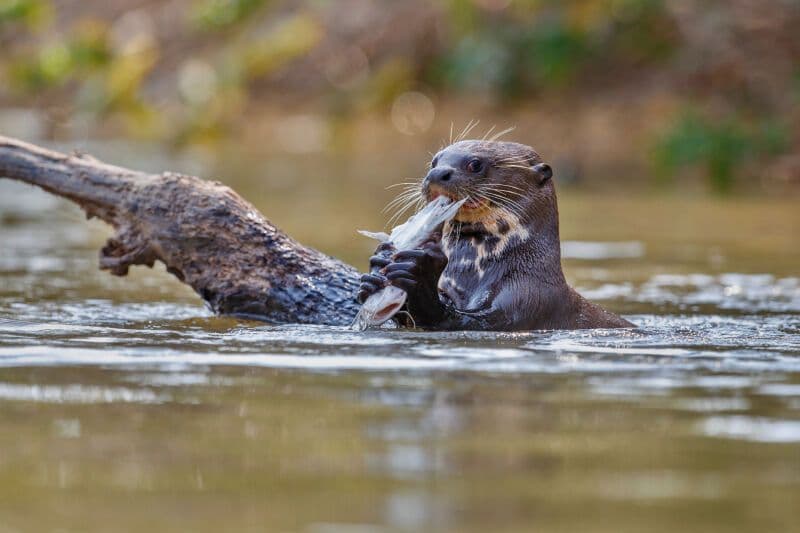
Giant otters are piscivorous carnivores, meaning that they mainly consume fish. If fish are not available, invertebrates such as crabs are also consumed.
Feeding advice Giant otter
Feed quantity per day
10%
Sample percentage calculation
If an animal weighs 24 kg and eats 10% of its body weight, it will get
24 x 0,1 = 2,4 kg feed in total per day
Feed composition
99% Fish products
1% Supplements
Proportions (fresh product)
0,99 x 2,4 kg = 2.376 g fish products
0,01 x 2,4 kg = 24 g supplements
Feeding advice Giant otter
Feed quantity per day
10%
Sample percentage calculation
If an animal weighs 24 kg and eats 10% of its body weight, it will get
24 x 0,1 = 2,4 kg feed in total per day
Feed composition
99% Fish products
1% Supplements
Proportions (fresh product)
0,99 x 2,4 kg = 2.376 g fish products
0,01 x 2,4 kg = 24 g supplements
Diet Suggestions
Recommended
Variety of fish
Supplements
In moderation
Oily fish
Not recommended
Common diseases
An unbalanced diet may result in one of these more commonly occurring diseases/conditions:
- Urinary stones
- Peritonitis
- Renal Calculi
- Hepatic lipidosis
- Osteoporosis
Additional advice
- Divide the “Feed quantity per day” over at least three feeding moments per day.
- The supplements should be given according to the appropriate dosage that is mentioned on the labelling.
- Avoid oxalate-rich components to prevent kidney stones.
- Stimulate foraging behaviour by using ice cubes with frozen fish, large fish heads and feed balls stuffed with fish (read more about feed enrichment and foraging behaviour).
Diet Suggestions
Recommended
Variety of fish
Supplements
In moderation
Oily fish
Not recommended
Common diseases
An unbalanced diet may result in one of these more commonly occurring diseases/conditions:
- Urinary stones
- Peritonitis
- Renal Calculi
- Hepatic lipidosis
- Osteoporosis
