


Warning: Expected delivery min. 5 days
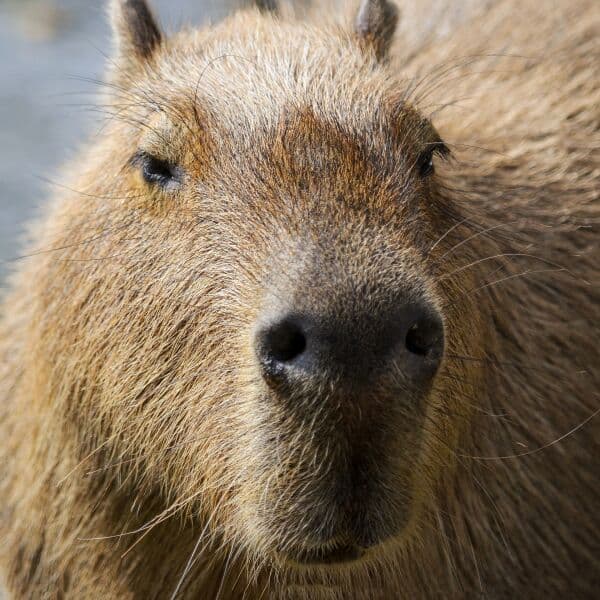
More informationCapybara
Hydrochoerus hydrochaeris
Natural diet Capybara
The capybara is classified as a herbivorous grazer. However, in captivity they are often fed as browsers since they select protein rich components (e.g. aquatic plants and crops). They also consume their own feces (coprophagy), which essentially allows them to digest their feed twice.



Feeding advice Capybara
Feed quantity per day
2%
Sample percentage calculation
If an animal weighs 50 kg and eats 2% of its body weight, it will get
50 x 0,02 = 1 kg feed in total per day
Feed composition
10% Concentrates
10% Leafy greens and cabbages
30% Grass, alfalfa, roughage
50% Browse
Proportions (fresh product)
0,1 x 1 kg = 100 g concentrates
0,1 x 1 kg = 100 g leafy greens and cabbages
0,3 x 1 kg = 300 g grass, alfalfa, roughage
0,5 x 1 kg = 500 g browse
Feeding advice Capybara
Feed quantity per day
2%
Sample percentage calculation
If an animal weighs 50 kg and eats 2% of its body weight, it will get
50 x 0,02 = 1 kg feed in total per day
Feed composition
10% Concentrates
10% Leafy greens and cabbages
30% Grass, alfalfa, roughage
50% Browse
Proportions (fresh product)
0,1 x 1 kg = 100 g concentrates
0,1 x 1 kg = 100 g leafy greens and cabbages
0,3 x 1 kg = 300 g grass, alfalfa, roughage
0,5 x 1 kg = 500 g browse
Diet Suggestions
Recommended
Variety of browse (willow, aspen, birch, rowan)
Capibara pellet (high fiber and vitamin C content)
Browse/ Leafeater pellets
Lucerne hay
In moderation
Leafy vegetables
Not recommended
Fruits
Common diseases
An unbalanced diet may result in one of these more commonly occurring diseases/conditions:
- Dental caries
- Obesity
- Scurvy (vitamin C deficiency)
- Malocclusion (teeth overgrowth)
- Colitis
- Cecities (inflammation)
- Type II diabetes
Additional advice
- Divide the “Feed quantity per day” over at least two feeding moments per day.
- Supply with sufficient vitamin C by feeding adequate concentrates.
- Supplement the diet with ad libitum browse and/or hay (read more about browsers and grazers).
- The browse used in the diet can be a mixture between dried and fresh browse.
- Feeding fruits might lead to abnormal fermentation in the hindgut because of high sugar levels (read more about nutritional values of (wild) fruits and vegetables).
- Stimulate foraging behaviour by hiding, stacking or hanging the feed (read more about feed enrichment and foraging behaviour).
Diet Suggestions
Recommended
Variety of browse (willow, aspen, birch, rowan)
Capibara pellet (high fiber and vitamin C content)
Browse/ Leafeater pellets
Lucerne hay
In moderation
Leafy vegetables
Not recommended
Fruits
Common diseases
An unbalanced diet may result in one of these more commonly occurring diseases/conditions:
- Dental caries
- Obesity
- Scurvy (vitamin C deficiency)
- Malocclusion (teeth overgrowth)
- Colitis
- Cecities (inflammation)
- Type II diabetes

