


Success: Available from stock
More informationTapir
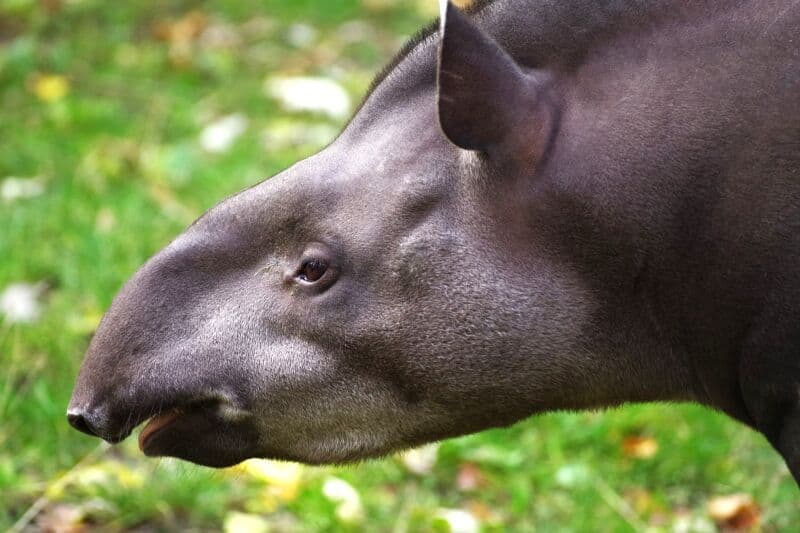
Tapirus spp.
Natural diet Tapir
Tapirs are frugivorous browsers and have an opportunistic feeding style. Therefore, their natural diet is diverse but largely consist of plants and fruits. However, this is dependent on their habitat and availability.


Feeding advice Tapir
Feed quantity per day
1,5%
Sample percentage calculation
If an animal weighs 200 kg and eats 1.5% of its body weight, it will get
200 x 0.02 = 3 kg feed in total per day
Feed composition
30% Concentrates
10% Leafy greens and cabbages
40% Grass, alfalfa, roughage
20% Browse
Proportions (fresh product)
0.3 x 3 kg = 900 g concentrates
0.1 x 3 kg = 300 g leafy greens and cabbages
0.4 x 3 kg = 1,200 g grass, alfalfa, roughage
0.2 x 3 kg = 600 g browse
Feeding advice Tapir
Feed quantity per day
1,5%
Sample percentage calculation
If an animal weighs 200 kg and eats 1.5% of its body weight, it will get
200 x 0.02 = 3 kg feed in total per day
Feed composition
30% Concentrates
10% Leafy greens and cabbages
40% Grass, alfalfa, roughage
20% Browse
Proportions (fresh product)
0.3 x 3 kg = 900 g concentrates
0.1 x 3 kg = 300 g leafy greens and cabbages
0.4 x 3 kg = 1,200 g grass, alfalfa, roughage
0.2 x 3 kg = 600 g browse
Diet Suggestions
Recommended
Lucerne hay
Variety of browse (willow, aspen, birch, rowan)
In moderation
Variety of leafy and cabbage vegetables
Grass hay
Not recommended
Fruits
Common diseases
An unbalanced diet may result in one of these more commonly occurring diseases/conditions:
- Iron storage disease
- Enterolithiasis
- Colic
- Acute Lameness
- Dental abscess
- Torsion
Additional advice
- Divide the “Feed quantity per day” over at least three feeding moments per day.
- Provide the less palatable feed components at the beginning of the day to reduce selective feeding.
- The browse used in the diet can be a mixture between dried and fresh browse (read more about browsers and grazers).
- The provided roughage should be an even mixture between lucerne and grass hay.
- Feeding fruits might lead to abnormal fermentation in the hindgut because of high sugar levels (read more about nutritional values of (wild) fruits and vegetables).
- Provide feed enrichment by scatter feeding or by using feeding puzzles, tubes, hanging baskets, boxes or balls (read more about feed enrichment and foraging behaviour).
Diet Suggestions
Recommended
Lucerne hay
Variety of browse (willow, aspen, birch, rowan)
In moderation
Variety of leafy and cabbage vegetables
Grass hay
Not recommended
Fruits
Common diseases
An unbalanced diet may result in one of these more commonly occurring diseases/conditions:
- Iron storage disease
- Enterolithiasis
- Colic
- Acute Lameness
- Dental abscess
- Torsion
Species within this group
Baird's tapir (Tapirus bairdii),
Malayan tapir (Tapirus indicus),
Mountain tapir (Roulin's tapir),
Northern lowland-tapir (Tapirus terrestris terrestris),
South American tapir (Tapirus terrestris)

